His fingers hovered over the keyboard. Then he remembered his hands
The short version
Between a trigger and a reply there is a door, and one breath opens it. Hands into the lap, right palm over left with the thumbs touching — the Dhyana Mudra — and one breath out longer than in. Then the question: am I reacting, or am I responding? The reply that follows is short and calm, and it is stronger than the one that was about to be fired off.
The email arrived like a slap. Accusations. Demands. His first instinct was to fire back — defend, explain, justify. His fingers hovered over the keyboard, the first brain in full command. Then he remembered the gesture.
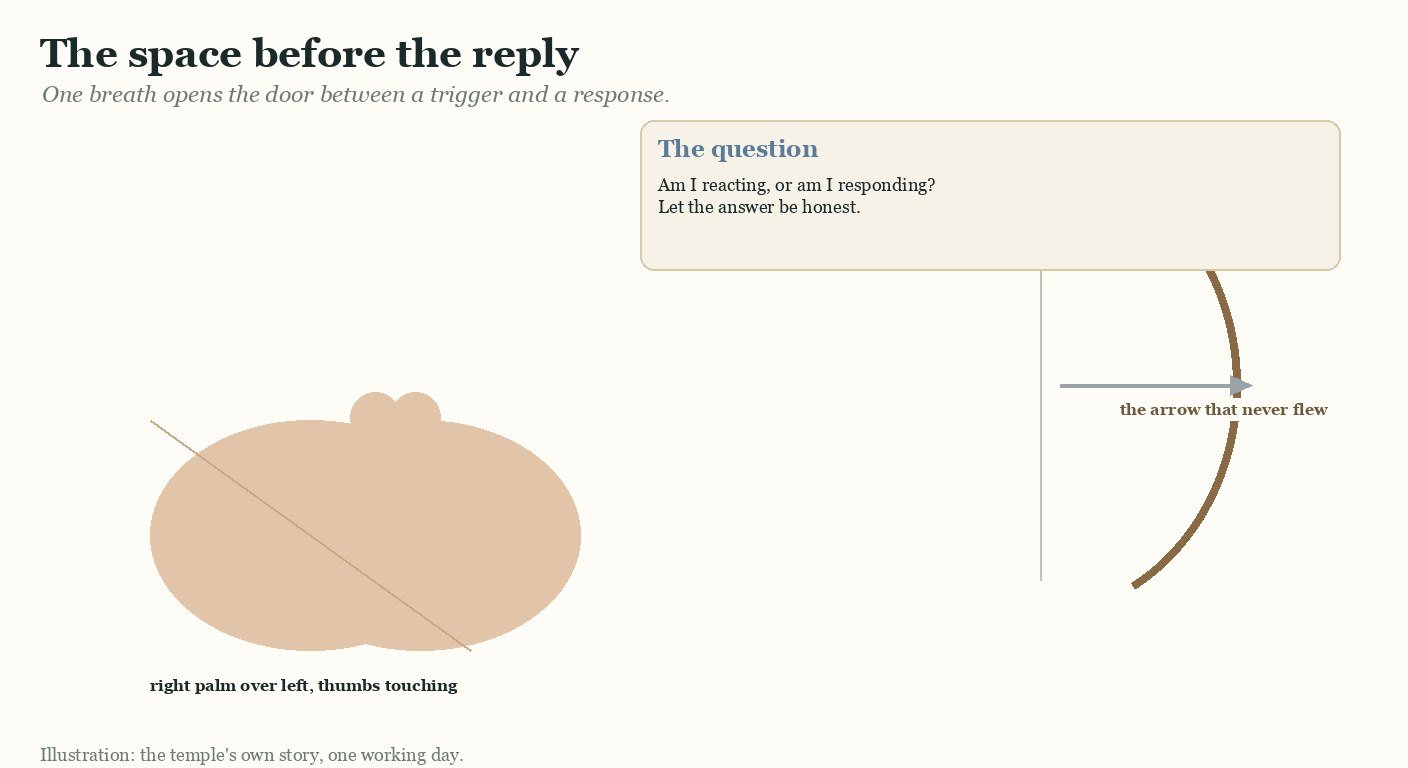
He placed his hands in his lap, right palm over left, thumbs gently touching. Dhyana Mudra. The mudra of meditation. He took one full breath, letting the exhale be longer than the inhale. And in that single breath, the impulse to react loosened its grip.
He asked himself: “Am I reacting, or am I responding?” The answer was clear. The email was still open, but the anger had dissolved. He wrote a short, calm reply — not from weakness, but from a place of quiet strength. The second brain had spoken.
Parable of the Bow
A warrior was insulted in the marketplace. His hand went to his sword. An old archer standing nearby said quietly, “An arrow released in anger always misses its mark. But one released from stillness — that arrow finds the center.” The warrior paused, his hand still on the hilt, and slowly released his grip. He walked away, not because he was weak, but because he had chosen his moment. The arrow that never flew had won the battle.
How to run it
- Stop typing. Hands off the keys and into the lap. The body moves first; the mind follows.
- Set the mudra. Right palm over left, thumbs gently touching — a gesture small enough to make anywhere.
- Take one breath, out longer than in. One is enough; the door is not a distance.
- Ask the question. Am I reacting, or am I responding? Let the answer be honest, not flattering.
- Reply from stillness. Short and calm — or wait, if no honest answer has arrived yet.
Where it fails
- Doing the mudra while still writing the reply in your head. The body becomes a prop, not a pause.
- Using the pause to plan a sharper answer. That is anger with better grammar.
- Deciding the pause is weakness. The pause is the moment the choice exists at all.
- Waiting for the anger to vanish first. The door works while the anger is still there; you do not need to feel calm to act calmly.
- Never replying and calling it Wu Wei. Avoidance is not stillness.
That day, he learned that the space between a trigger and a response is where Wu Wei lives. It’s not a void. It’s a door. And a simple hand gesture, held for one breath, can open it.
🧭 One breath, one gesture — the reaction ends, the response begins.