Effortless action begins with setting the stone down.
The short version
A heavy decision is not a verdict; the weight itself is the information. When the day feels like lifting a stone, the useful move is not harder pushing but one step back: notice where the weight sits, use a small anchor — a bead, a phrase, a breath — and look again from that seat. You are not the fatigue and not the list. You are the one who can set the stone down, and the next step usually arrives once the carrying stops.
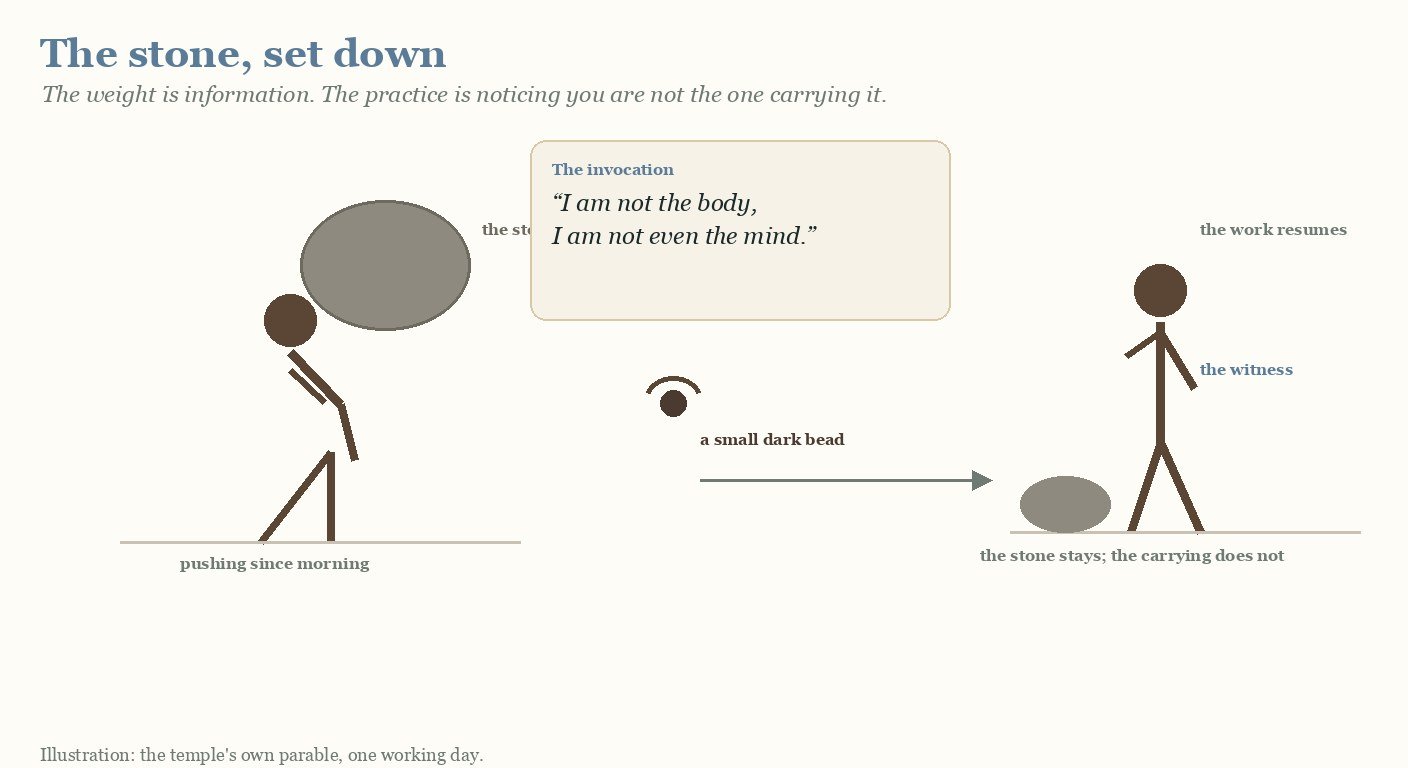
By late afternoon, he was dragging. Every task felt like lifting a stone. He had been pushing since morning, forcing solutions, grinding through the list. His shoulders ached, and his mind was a thick fog. He was completely in the first brain — analytical, reactive, exhausted.
On his desk sat a small, dark bead — a Rudraksha seed, given by a friend. He picked it up and held it in his palm. He didn’t know why. He just did. Then he recalled the invocation: “I am not the body, I am not even the mind.” He whispered it once. Then again.
Something shifted. He felt the weight of the day as a separate thing — not him. The stone was still there, but he was no longer carrying it. He was the awareness behind the fatigue, the witness. The bead, cool and textured, anchored him there. He breathed once more, deeply, and resumed his work — not from force, but from flow. The second brain had taken over.
Parable of the Traveler and the Stone
A traveler carried a large stone for many miles, believing it was precious. When he finally showed it to a wise woman, she laughed gently and said, “That stone is ordinary. You’ve been carrying it for nothing.” The traveler dropped the stone, and his whole body felt light. “I thought I needed it,” he said. The wise woman replied, “That’s the heaviest kind of weight — the one you never needed to carry.”
How to run it
- Notice the weight. Where does it sit in the body, and what sentence repeats behind it? Name it plainly before you name a solution.
- Stop pushing, for one breath. Set the task down for the length of an exhale, not for the afternoon. The stone is still there; you are not lifting it for that moment.
- Anchor. A small object in the palm, a phrase you actually believe, one slow breath. The bead in this story was not magic — it was a place to stand.
- Step back. Feel the weight as a separate thing, then look at the decision from that seat. The options do not change; the forcing drops out of them.
- Take the next single step. Not the whole list — the one next action. That is where Wu Wei stops being a phrase and starts being a working method.
Where it fails
- Using the phrase to avoid the decision. “I am not the body” is not a reason not to choose; it is a way to choose without the panic.
- Needing the bead. The object is a reminder, not the practice. If you cannot act without it in your hand, the reminder has become the stone.
- Waiting to feel light before deciding. The witness is not a mood. The step-back can happen in a bad afternoon, exactly as it did here.
- Stopping at the breathing. Rest and avoidance look identical from inside; the difference is whether you come back to the task.
- Turning it into a performance. A public calm does not set anything down. The practice is invisible by design.
Sometimes the effort we exert is not required. The bead and the phrase are reminders that you are not the fatigue, not the stress, not the endless doing. You are the one who can set it down. That is Wu Wei — not doing nothing, but doing without the extra weight.
🧭 Set down the stone. The next step comes without effort.