Effortless action begins with setting the stone down.
The short version
Some weights are not yours, and you can tell which by setting them down. The old story is a test, not a moral: carry a stone for miles and you will call it precious; set it down and the body answers honestly. This page is an audit of what you are carrying — habits, grudges, other people’s expectations — and a way to put down what does not change when you do.
Everyone carries something they think is precious. An obligation taken on out of habit. A grudge kept like a receipt. A project that was someone else’s expectation, still cold in your hands. None of them get lighter with time; they only get carried longer, and the carrying is what tires you.
The test is not a thought, it is an experiment. Set the thing down for a day — not forever, just a day — and see what actually happens. If the world does not end, the stone was ordinary all along. If something real does pull at you, a person, a promise, a cost you genuinely owe, that is worth knowing too, and it is not the same thing as a weight carried out of habit.
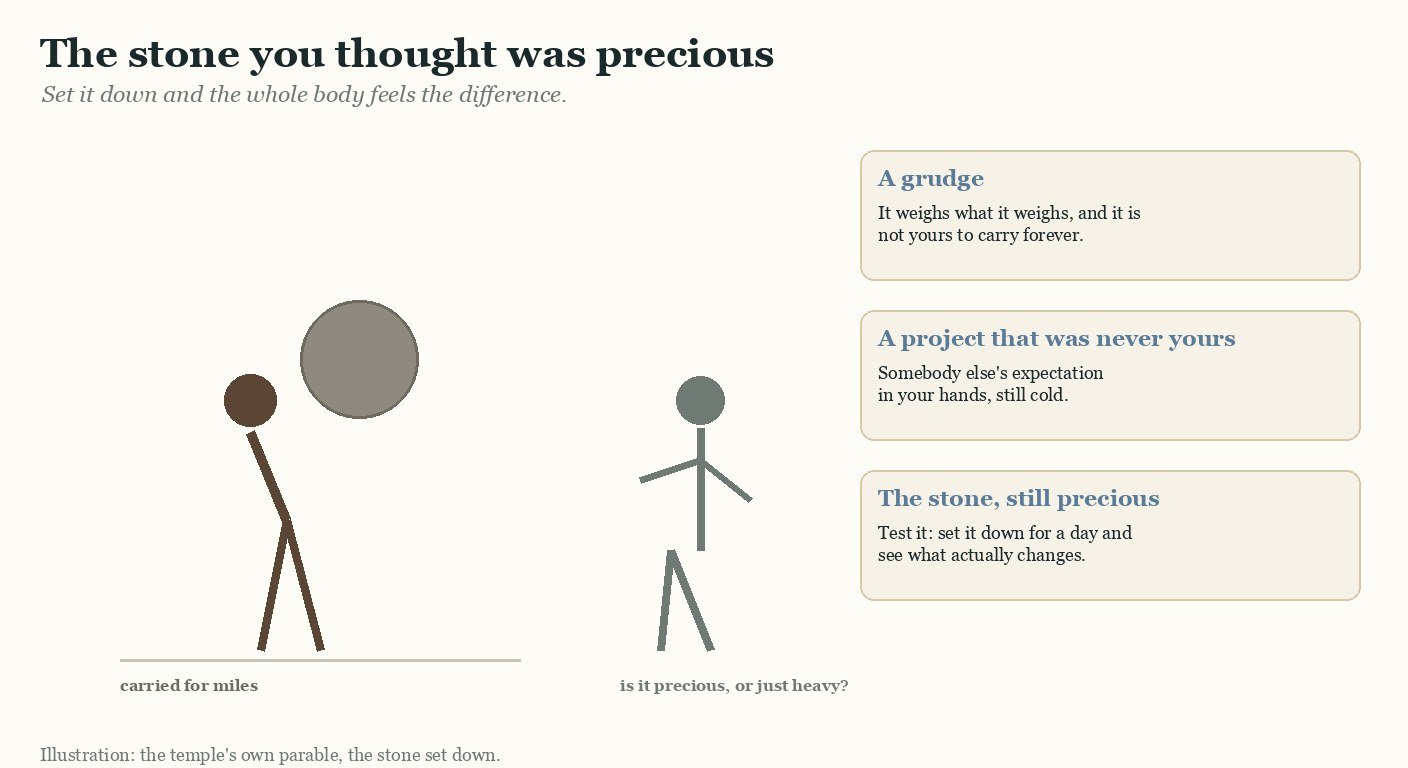
You are not the fatigue, and you are not the load. You are the one who can set it down — or pick it up again, deliberately, with both hands and a reason.
Parable of the Traveler and the Stone
A traveler carried a large stone for many miles, believing it was precious. When he finally showed it to a wise woman, she laughed gently and said, “That stone is ordinary. You’ve been carrying it for nothing.” The traveler dropped the stone, and his whole body felt light. “I thought I needed it,” he said. The wise woman replied, “That’s the heaviest kind of weight — the one you never needed to carry.”
How to run it
- List the loads. Write down everything you are carrying this week: tasks, obligations, grudges, other people’s expectations.
- Name each one’s owner. Did you choose it, or did it arrive? The answer is usually obvious and uncomfortable.
- Set it down for a day. Not forever, not a disappearance — one day of not carrying it.
- Ask what changed. If nothing did, it was habit. If something did, it is real and can be carried deliberately.
- Pick up only what you chose. With both hands, a reason, and a plan for when it gets heavy again.
Where it fails
- Calling everything precious because it is heavy. Weight is not evidence of value.
- Setting down everything at once. That is not an audit, it is a collapse.
- Testing by abandoning responsibility. The test is a day, not a disappearance.
- Deciding a weight is “not mine” to escape a cost you actually owe. The audit should find the real ones too.
- Waiting to feel light before acting. The body answers after the test, not before.
- Carrying a grudge like a receipt. A receipt is only worth something if the other side honors it.
Sometimes the effort we exert is not required. The bead and the phrase are reminders that you are not the fatigue, not the stress, not the endless doing. You are the one who can set it down. That is Wu Wei — not doing nothing, but doing without the extra weight.
🧭 Set down the stone. The next step comes without effort.