Water, Kept Honestly
On sandy ground, rain is a rumor. It arrives, it touches the surface, and it is gone — down through the gaps, past the roots, into the deep where nothing can reach it. The garden stands thirsty while the water table stands full.
The old answer is the simplest one: keep the water where the roots live. Three tools, each older than plumbing:
The short version
Catch the roof run in a 55-gallon barrel on a solid stand. Bury an unglazed olla to its neck at the dripline and refill it every few days. Keep the bed covered with a living mulch that shades the sand and goes back into it. One inch of rain on 100 square feet of roof is about 62 gallons, so a single storm fills the barrel — and a full barrel weighs about 450 lb, so the stand matters as much as the barrel. Three tools, one system, and none of them needs a pump.
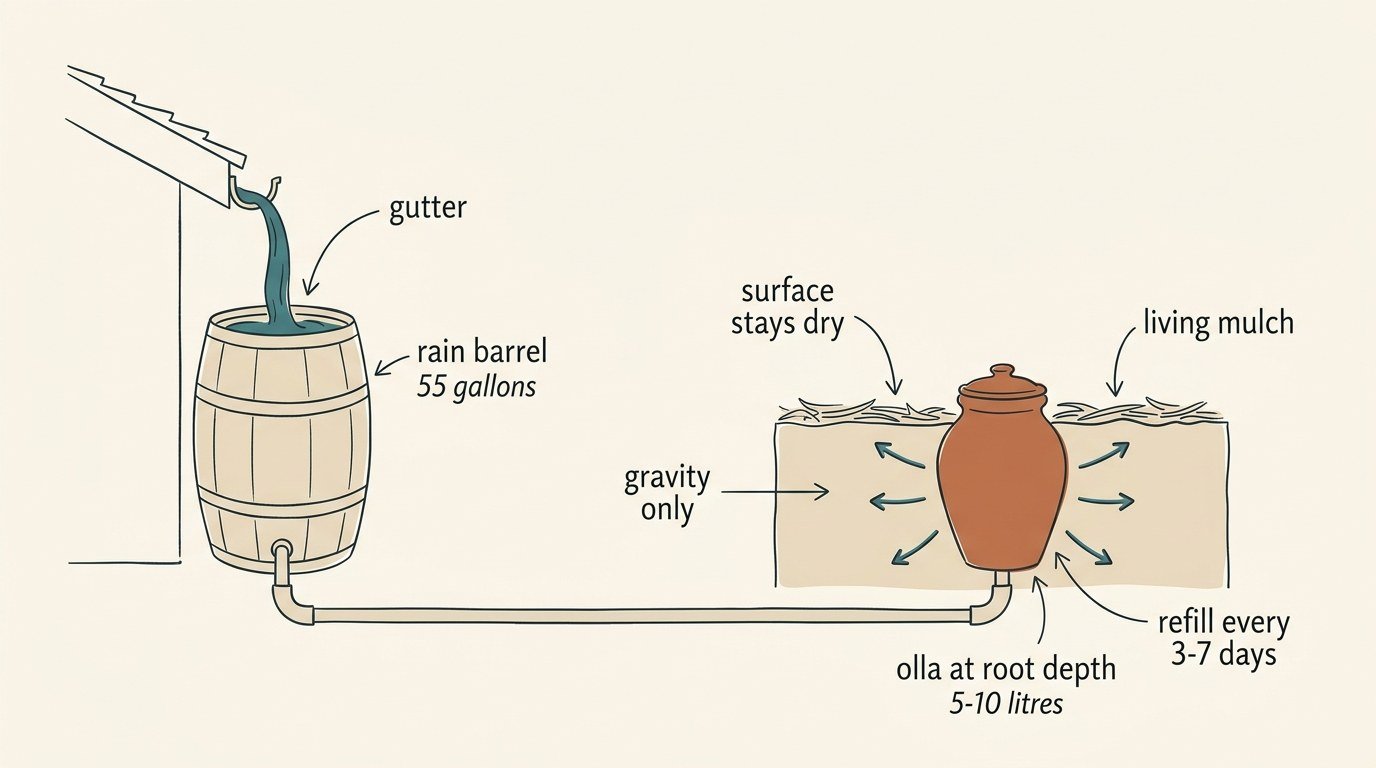
The rain barrel. A 55-gallon barrel under the best roof run, fed by the gutter the shed already has. No pump, no filter, no electricity — just gravity, and the rain that would have run away.
The olla. An unglazed clay pot buried to its neck, filled once, capped. The soil pulls water through the pot's pores only as it dries — a valve with no moving parts, metering moisture at root depth while the surface stays dry.
The living mulch. Cover crops — Sunn hemp in the heat — that shade the soil, break the hardpan, and feed the ground as they die back. Water held, water rationed, water feeding the biology that holds more water.
How to run it
- Catch the roof run. A 55-gallon barrel under the best roof run, on a solid stand, with the spigot low enough to fill a watering can. Size the overflow for a downpour, because one storm fills it.
- Bury an olla at the dripline. Unglazed, five to ten litres, set to its neck with no air gap along the wall, then capped. Refill every three to seven days in summer.
- Cover the bed. A living mulch — sunn hemp in the heat — shades the surface, breaks the hardpan with its roots, and its residue goes back into the sand.
- Use each for what it is good at. The barrel for establishment and emergencies, the olla for steady water at root depth, the mulch for everything in between. Together they are one system, not three gadgets.
Where it fails
- Bad footing under the barrel. A full one is about 450 lb and will tip. Blocks on solid ground, not on soil.
- A high spigot. It strands the bottom third of the barrel, which is the water you needed in the dry week.
- A translucent barrel. Light grows algae; the water turns green and the barrel becomes a pond.
- Glaze, an air gap, or no cap. A glazed pot is a jug, an air gap kills the capillary contact, and an open mouth is an evaporation chimney.
- Pulling the mulch off to tidy up. That undoes the third tool and the surface dries by the next afternoon.
- Relying on one alone. The barrel empties in a dry spell, the olla is slow, and the mulch is not a water source. The system is the point.
These three are the temple's Water-Wise Garden Bundle: rain catchment, olla irrigation, and biological soil building. Each is a full guide; together they are a complete drought-resilience system for sandy ground. The free pages are on the site — read them first, then take the guides with you.
The Water-Wise Garden Bundle ($17) →
3 guides · $21 separately, $17 together · instant delivery