If you are forcing something and it is not moving, the fix is usually not more effort — it is less. That is the whole of this parable: a young archer aims harder and misses, and an old master stops interfering and hits the center. The practice that follows takes two minutes a day, and it is the difference between pushing at the work and letting it complete.
The parable
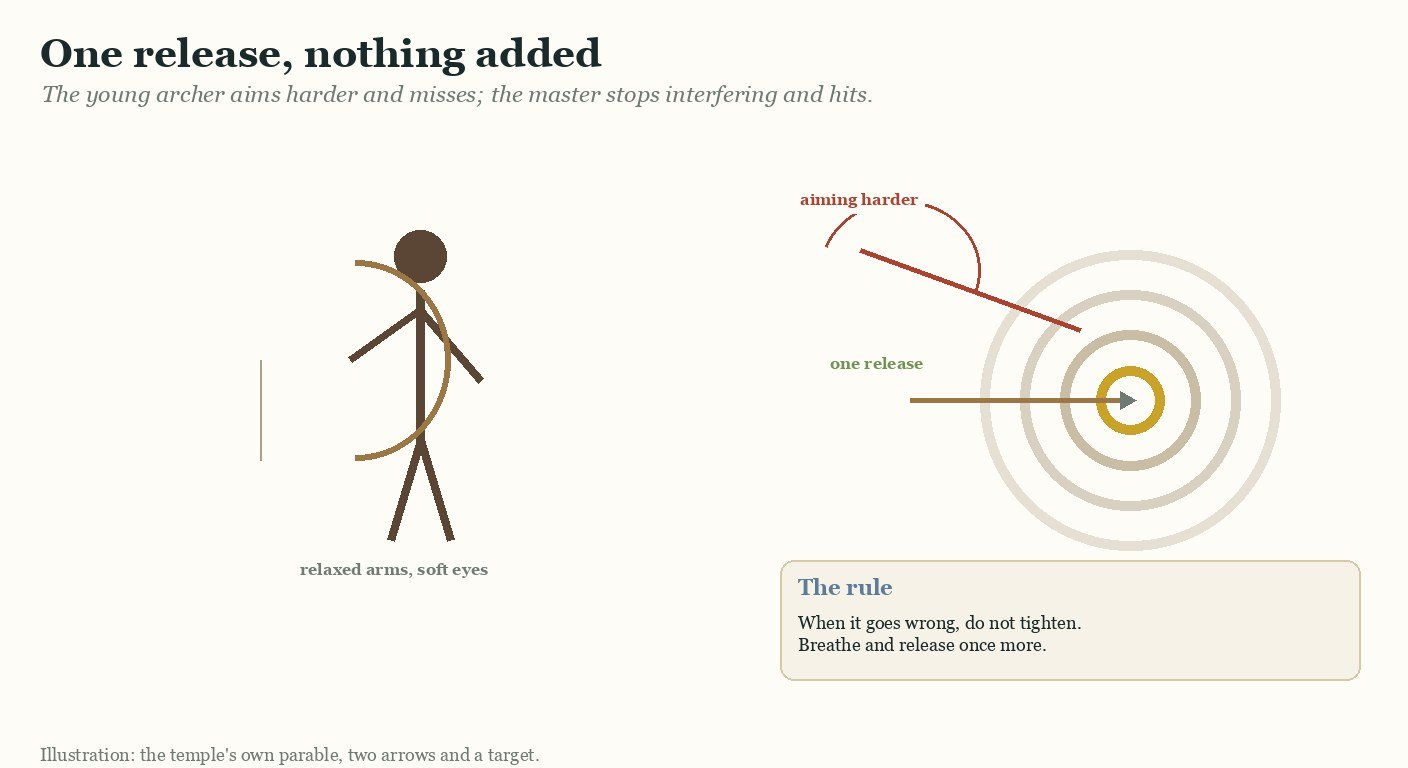
A young archer wanted to hit the center of the target, so he did everything a serious archer does. He aimed harder. He gripped the bow tighter. He calculated the angle, measured the wind, adjusted his stance, and tensed every muscle before he released. Most of his arrows missed. A few grazed the edge. None struck the center.
An old master watched from the shade of a pine tree and said nothing. Day after day he watched the young man exhaust himself in pursuit of the perfect shot, and still he said nothing.
Then one afternoon the master rose, picked up a bow that had been lying unused on the ground, and breathed once — a slow, unhurried exhale. He raised the bow without seeming to aim. His arms were relaxed, his eyes soft. He released. The arrow struck the exact center of the target.
The young archer stared. “How did you do that?”
The master said, “I didn’t. The bow, the arrow, the target — they were already one. I just stopped interfering.”
What the story is actually saying
The young archer’s mistake was not a lack of effort. It was the extra force — the tension, the overthinking, the need to control the release. Every added adjustment moved the arrow further from the center, because it moved his attention off the act itself and onto his worry about the act.
This is what the method calls the shift from the first brain to the second: from the racing, calculating mind to the quieter knowing behind it. Wu Wei is not doing nothing. It is doing the right thing at the right moment, without pushing against the current. You do not stop acting; you stop interfering with the action.
The practice this week
Pick one thing you are currently forcing — a project that won’t move, an email you keep rewriting, a conversation you keep rehearsing. Before you touch it each day this week, sit for two minutes and let the thoughts settle: count your breaths, one on the inhale, two on the exhale, up to ten, then start again. When a thought comes, notice it and return to the count. You are not emptying the mind; you are letting the storm settle.
Then do the thing once, without adding anything — no re-checking the angle, no tensing up. One release. If it goes wrong, do not tighten; that is the young archer’s reflex. Take the breath again and release once more. The arrow does not need you to aim harder. It needs you to stop interfering.
How to run it
- Pick one thing you are currently forcing — a project that will not move, an email you keep rewriting, a conversation you keep rehearsing.
- Sit for two minutes before touching it and count ten breaths. No plan, no rehearsal.
- Do the thing once, without adding anything — no re-checking the angle, no tensing up.
- If it goes wrong, do not tighten. That is the young archer’s reflex; breathe and release once more.
- Stop at one release a day for the week. The practice is the not-adding, not the score.
Where it fails
- More effort as the reflex. That is the young archer: every adjustment moves the arrow further out.
- Rehearsing instead of releasing. Planning is another way of holding the string.
- Doing the breathing as a ritual and then skipping the action.
- Tightening after a miss. The second arrow is where the first mistake becomes a habit.
- Calling one good shot mastery. The practice is the not-adding, repeated; not the lucky hit.
The short version
The archer missed because he aimed harder, and the master hit because he stopped interfering. The practice is the same in daily work: sit for two minutes and count your breaths, then act once without adding force. Wu Wei is not doing nothing. It is removing the extra effort so the natural pattern can complete itself.
From the Effortless Action (Wu Wei) method