A Practice of Shen‑Led Wu Wei
Sending thanks is one of our oldest gestures. Traditionally, we put pen to paper, sealed an envelope, and waited for the mail to carry our words. Today, a quick text or a flashy digital card often takes its place. But there is a quieter way—one that honors the sincerity of the gesture without the rush.
The short version
A quiet e-card is a small, deliberate pause sent to someone else. One image, three lines, no template noise — the point is not the card but the stillness it carries. Send it while the memory is still warm, ideally within two weeks, and write it like a letter rather than a broadcast. The practice costs minutes; the difference it makes lasts longer than the medium suggests.
Why a Quiet E‑Card?
When you choose a minimalist e‑card, you step out of the noise. You aren’t just sending a template; you are sending a moment of stillness.
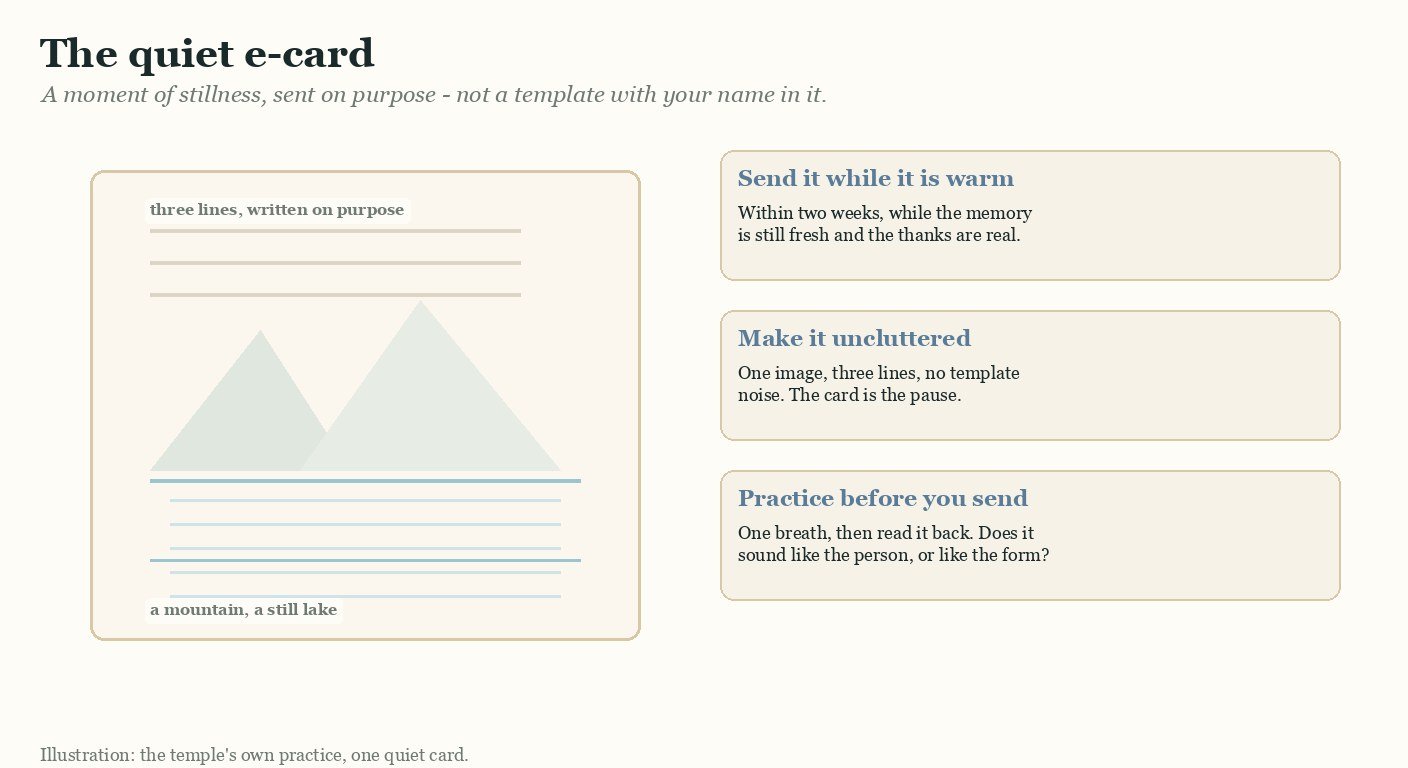
In Daoist thought, the Shen (Spirit) gives a gesture its weight. A card sent from a place of calm carries a completely different resonance than one sent out of obligation. It becomes a modern vessel for Wu Wei (Effortless Action). You don’t force the moment. You select a quiet image, add a simple word, and let it reach the other person without demanding anything in return. No marketing tracking, no hidden bloat, no obligation.
When to Send
The occasions are both ordinary and profound:
- 🌿 After a Gathering or Milestone: When friends have gathered and you wish to honor their presence.
- 🕊️ In Moments of Loss: When words feel thin, but a silent acknowledgment carries more weight than a long letter.
- ✨ In Everyday Resonance: Simply when someone crosses your mind and you wish to acknowledge the connection.
Daoist tradition reminds us that timing is part of the gift. Send the card while the moment is alive—ideally within two weeks. Not because of an arbitrary rule, but because it follows the natural flow; the memory is still fresh, the heart still open.
Making It Your Own
A sincere e‑card doesn’t need elaborate, bloated design. It needs your genuine presence. Choose uncluttered visuals—a mountain, a still lake, an open hand. These aren’t decorations; they are visual anchors reminding the recipient that this came from a real person in a quiet moment. Add a short line, a simple verse, or just your name, allowing the right words to surface on their own.
How to run it
- Pick the occasion. Thanks, a memory, an apology, a small kindness observed. The card is for a moment, not a mailing list.
- Choose one uncluttered image. A mountain, a still lake, an open hand. No template clutter, no clip art.
- Write three lines. One to name the thing, one to say what it meant, one to thank. Then stop.
- Read it back before sending. Does it sound like the person, or like the form? Cut what sounds like the form.
- Send it while it is warm. Within two weeks; the memory is the gift, and it has a season.
Where it fails
- Using a template and calling it a gesture. The card is not the message; the writing is.
- Sending out of obligation. A card sent because you should sounds exactly like one sent because you should.
- Letting the design carry the meaning. A beautiful card with nothing written in it is decoration.
- Waiting for the perfect words. Three plain lines now beat one perfect line that never leaves the drafts.
- Sending it months later. The moment is the occasion. Late thanks read as a reminder of a debt, not a gift.
A Small Practice Before You Send
Before you click “send,” pause. Take three slow breaths. Place your hand over your heart and think of the person you are thanking. Let the feeling of gratitude rise naturally without forcing it.
With that stillness alive in you, let the message go. This turns a simple digital communication into an act of Shen—a tiny, sincere bridge between you and another human being.
🧭 Where This Fits in the Temple
This quiet practice touches all five methods. When you send a spiritual e‑card, you move through the whole framework naturally:
- 🏔️ Three Sacred Treasures: The pause before sending is a miniature Shen‑clearing. You settle the spirit so the gesture is genuine.
- 🌤️ Three Powers: Ask — Heaven (is this the right time?), Earth (what medium fits the person?), Human (what words are truly mine?).
- 🌊 Five Elements: Choose a card that mirrors the element you wish to convey — Water for comfort, Wood for growth, Fire for warmth, Earth for stability, Metal for clarity.
- ⚛️ Wisdom Reactor: Notice what shifts inside you when you send without expectation. Observe the return without clinging.
- 🌉 Bridge / Shū (樞): The e‑card is a small hinge — a still point connecting two people across time and space.
A student once asked the old teacher, “What is the best way to thank someone?” The teacher handed him a blank piece of rice paper and a cup of tea. “Write nothing,” the teacher said. “Let the steam carry your silence.” The student understood: the most sincere thanks often requires the fewest words.
🖐️ A quiet practice from the temple. Return to diyminer.com for more free methods.