In southwest Florida the first frost is not a date you can trust, which is why the shutdown has an order. On the coast a frost night is uncommon and a hard freeze rarer still; inland runs colder and earlier, and a low open spot beats either. The nearest long record, Orlando, puts the first 32°F freeze in January in a typical year: a median of 10 January, with one year in ten arriving before 18 December. Frost can form on a leaf on a clear, still night when the air never reaches freezing. So the work below belongs in the four to six weeks before that window, and the order is water first, clay second, soil third. Everything else can be redone in spring. These cannot.
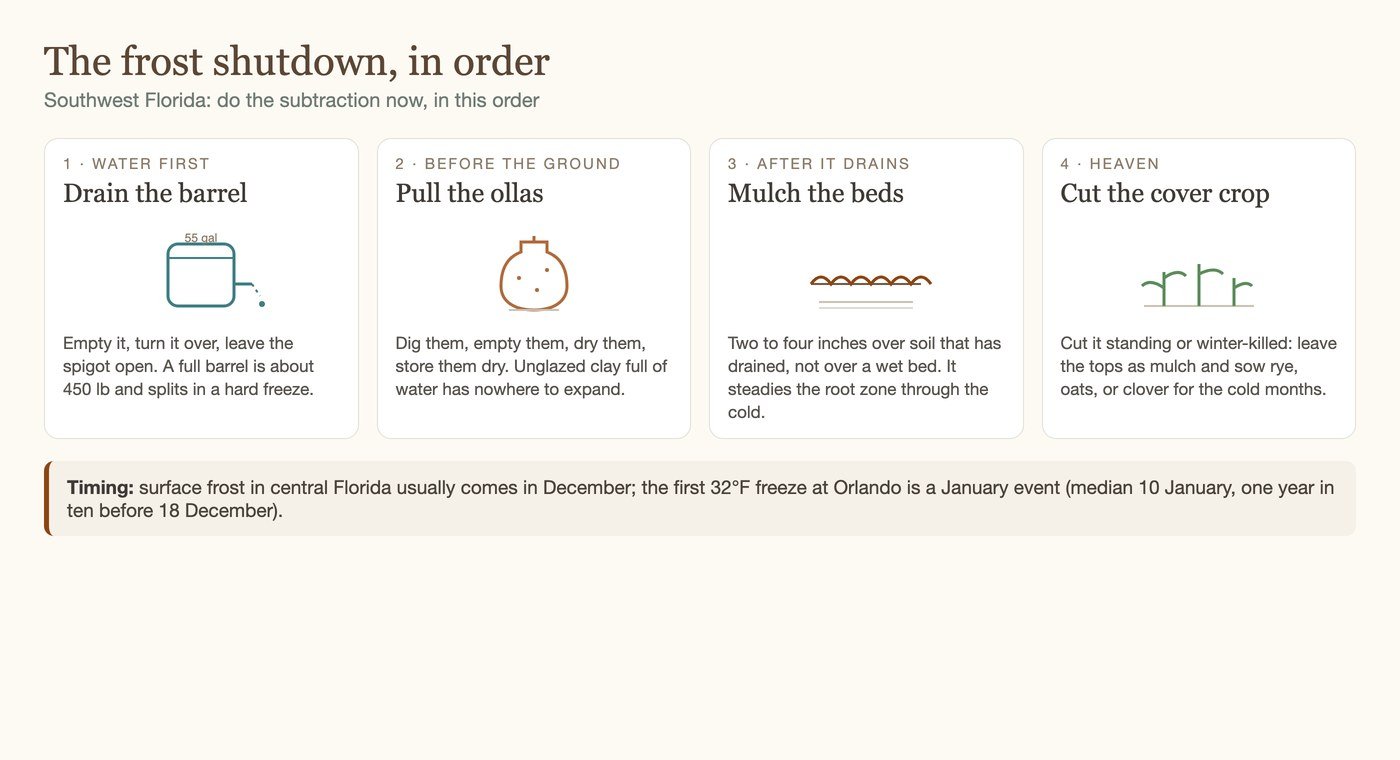
The short version
- The first freeze is a January event here, so the prep window is now, not the first cold night.
- Drain the barrel before anything else: it holds about 450 pounds of water and a hard freeze splits it.
- Pull the ollas, empty and dry them, store them dry. Clay full of water cracks.
- Mulch after the beds drain, cut the standing cover crop, and keep the row cover for the cold nights.
The frost calendar, plainly
NOAA's 1991–2020 climate normals put the median first fall freeze at the Orlando station on 10 January. The one-in-ten early date is 18 December, and that station records a freeze in only about six years out of ten. Coast and inland do not share a date: the coast holds warmth later, inland and northern counties run earlier, and the ground in a low, open spot freezes before the ground under trees.
Those are the Orlando station’s numbers — the nearest published 1991–2020 record, not a local one. Coastal southwest Florida freezes later and in fewer years than Orlando; inland southwest Florida runs colder and earlier than the coast. Read the Orlando date as the outside edge of the window, and the first mid-30s forecast as the trigger.
Two practical readings follow from that. First, a November cold snap that leaves the water in the barrel liquid can still burn the tops of tender plants, so frost protection is worth having ready before the freeze that the numbers describe. Second, a December forecast in the mid-30s is the signal for the shutdown, not a November one, unless the forecast says otherwise that week.
Why this order and not another
Water first. A 55-gallon barrel holds about 450 pounds of water. Left full through a hard freeze it splits, and spring starts with a broken barrel and wet ground. Emptying it is fifteen minutes. The catchment guide gives the build; this is the end-of-year move.
Clay second. Unglazed terracotta is porous by design, and a pot full of water has nowhere to expand when the water freezes. Dig the ollas while the ground still gives, empty them, and let them dry before storage. A cracked pot is a dead pot.
Soil third. Mulching a saturated bed holds the water in instead of holding the warmth in. Let the beds drain first, then cover them.
Sky last. A standing summer cover crop will winter-kill anyway; cutting it while it is still easy to cut leaves the tops as mulch. If the bed should carry through rather than rest, sow a cold-season cover in its place.
How to run it
- Watch the night forecast, not the calendar. The trigger is the first night forecast in the mid-30s, not a fixed date.
- Drain the barrel: shut the downspout, open the spigot, empty it, tip it over, and leave the tap open so any water left runs out.
- Let the roof shed to the ground until spring. The overflow and the gutter need nothing else.
- Dig the ollas, empty them, scrub the inside, and dry them in the sun for a few days before storing them dry and covered.
- Wait for a dry spell before mulching. Two to four inches over the bed steadies the root zone; keep it clear of crowns and stems.
- Cut the standing cover crop at the base and leave the tops where they fall as mulch. If you are sowing instead, rye and oats for erosion armour, crimson clover or vetch for nitrogen.
- Keep the row cover for the nights, not the days: cloth over hoops by evening, off by morning, and never touching the leaves.
- Write one line for next year: the date of the first frost, what cracked, what survived.
If the frost comes before you are ready
A forecast freeze with work undone is not a disaster, but the order changes. Drain the barrel first, that evening: a full barrel is the expensive loss and the only one that cannot be repaired. Pick anything tender the evening before; green tomatoes ripen indoors. If an olla is still buried, do not dig frozen ground for it. Expect a cracked pot and replace one, not five. If the beds are bare, a sheet of row cover over hoops buys a few degrees for the night.
What it costs
The shutdown costs an afternoon and no money. It reuses what is already on the site: the barrel, the blocks, the pots, the mulch from the last cut. The only purchase in a bad year is a replacement olla, and the only real cost of skipping it is the barrel.
Where it fails
- Waiting for the first frost to drain the barrel. By then the water is already ice, and ice is what splits it.
- Mulching a wet bed and locking the water in for the winter.
- Storing ollas damp: they go green, then they smell, then they crack.
- Cutting the cover crop and leaving bare soil, so the winter rain runs off and takes the top with it.
- Leaving row cover on through a warm day, which cooks the bed it was meant to protect.
- Using the coast's date inland. The coast holds warmth; a low inland bed does not.
The freeze is not the enemy. A full barrel and a buried pot are the enemy, and both are reversible for the next few weeks. The cover-crop guide and the ground-cover guide cover what to put in the beds afterwards.