You're probably paying for 2-3 AI subscriptions right now. ChatGPT. Claude. Maybe something else. That's $40-60/month before you've done anything useful.
You don't own any of it. You can't modify it. You can't run it offline. You can't control what happens to your data. Every prompt you type goes to someone else's server. Every document you upload trains someone else's model. And if they raise prices, change the terms, or go down — you have nothing.
Even if you're not paying, you're still subsidizing it. The big AI companies are burning billions of dollars a year — some of the largest losses in tech history. That money comes from somewhere: investors, future price hikes, or your data being used to train their next model. The current price isn't sustainable. It never was.
Meanwhile, open-source models like DeepSeek and tools like Ollama are proving you don't need any of that. You can run capable models on your own hardware, for a fraction of the cost, with full control over your data.
But a model alone isn't enough. You need an interface that turns it into a working tool — an AI agent that can actually do things.
The short version
You are probably paying for two or three AI subscriptions and owning none of them. A stack you own is four tools: an open-source model, a wallet you pay by the request, an agent that runs on your machine, and an automator for the recurring work. The subscriptions go away, the data stays local, and nobody can change the terms on you.
The Solution
You can build your own AI stack. No subscriptions. No middlemen. No data leaving your machine.
An AI stack is just the collection of tools you need to run AI yourself — a model, a wallet for access, an interface to use it, and automation to make it work without you.
You pay pennies for what you use. Your data stays where it belongs. Nobody can change the terms on you because you own the whole thing.
The Stack
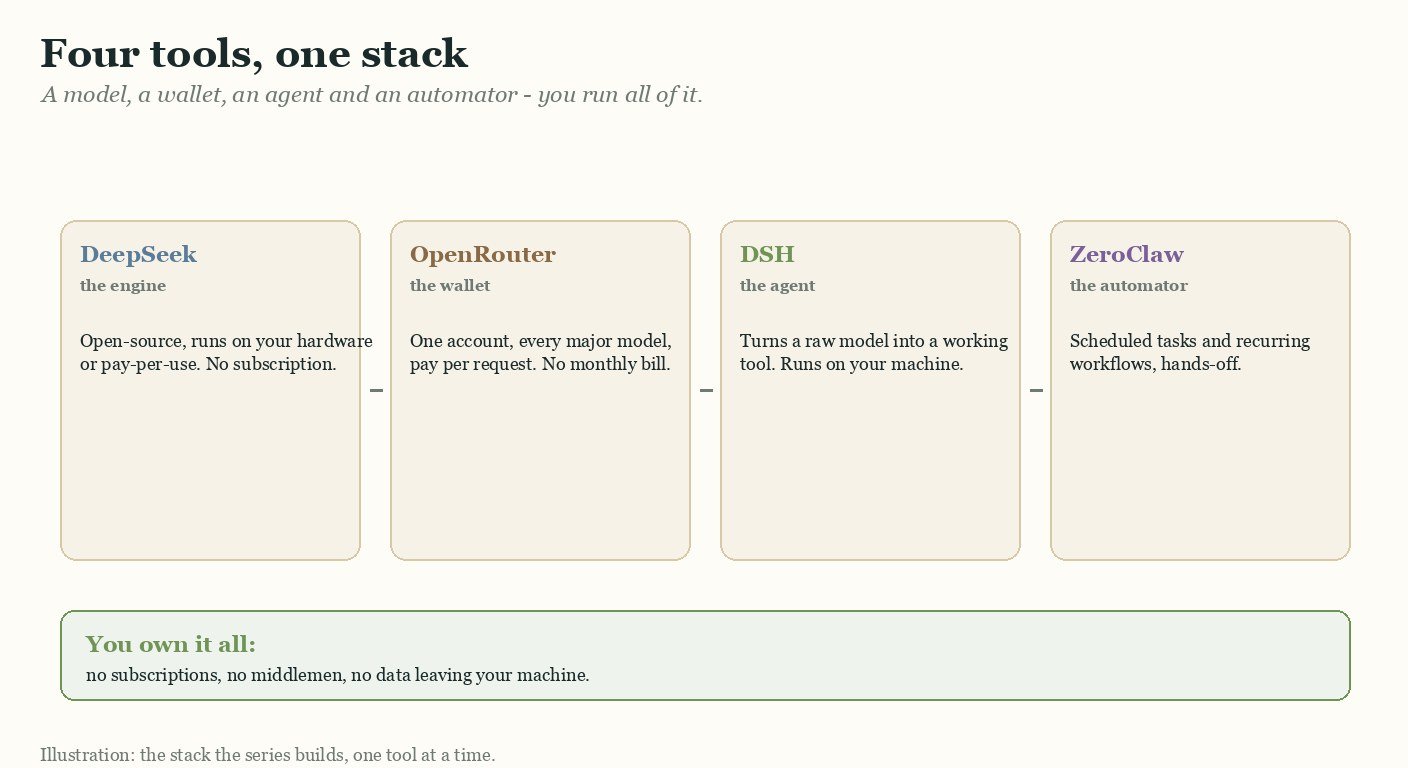
DeepSeek is the engine — open-source, capable, runs on your own hardware or pay-per-use. No subscription.
OpenRouter is the wallet — one account, every major model, pay per request. No monthly bill.
DSH is the agent — the interface that turns a raw model into a working tool. Chat, files, web search, automation. Runs on your machine.
ZeroClaw is the automator — scheduled tasks, recurring workflows, hands-off operation while you sleep.
Four tools. One stack. You own it all.
How to run it
- Start with the model. DeepSeek is open-source and runs on your own hardware or pay-per-use. No subscription.
- Add the wallet. One OpenRouter account reaches every major model, paid per request.
- Put an agent on top. DSH turns the raw model into a working tool: chat, files, web search, automation, on your machine.
- Automate the recurring work. ZeroClaw handles scheduled tasks and hands-off workflows.
- Own the pieces. Each tool is separate, so nothing can change the terms on the whole stack at once.
Where it fails
- Paying for a model and calling it a stack. A model alone is not an agent; the interface is the work.
- Keeping the subscription as a backup. That is the same bill with extra steps.
- Skipping the wallet. One account for every model beats a dozen API keys and cards on file.
- Automating before it works by hand. ZeroClaw multiplies whatever the stack already does, good or bad.
- Believing ownership is free. It is cheap, not free: hardware, a little power, and the time to learn.
What's Coming
This series walks through each tool, step by step. Watch one video, get one working tool. Stop whenever you want. You always own what you built.
We start with DeepSeek. Then OpenRouter. Then DSH. Then ZeroClaw. And finally, we apply everything with the five self-educator tools — Advisor, Librarian, Tutor, Editor, and Explorer.
No hype. No upsell. Just the tools, shown plainly.